
DLCO, TLCO and KCO: Understanding the Lung Gas-Transfer Test
Spirometry shows how air moves through the airways. A DLCO test answers a different question: how effectively gas passes from the air sacs of the lungs into the bloodstream. It can reveal an important abnormality even when basic spirometry is normal.
Medically reviewed and approved by Dr G Sarwar Chaudhry, MBBS, FRACP (Australia), FCCP (USA), Consultant Pulmonologist and Sleep Physician · Updated 23 September 2026.
What is a DLCO or TLCO test?
DLCO stands for diffusing capacity of the lung for carbon monoxide. TLCO means transfer factor of the lung for carbon monoxide. These are two names for the same overall gas-transfer measurement; DLCO is commonly used in North American literature, while TLCO is often used in the United Kingdom, Europe and Australia.
During the test, the patient inhales a carefully controlled diagnostic mixture containing a very small concentration of carbon monoxide and a tracer gas. After a short breath hold, the exhaled sample is analysed. Because carbon monoxide binds readily to haemoglobin, the amount taken up provides a practical estimate of transfer from the alveolar gas to pulmonary capillary blood.
The quantity used is very small and the test is generally safe when performed in an appropriate patient under standard laboratory procedures. The test does not measure oxygen directly, but it provides clinically useful information about the pathway that oxygen also needs to cross.
Why do we need a DLCO test?
Two patients can have similar spirometry results but very different gas-transfer function. Conversely, someone may have normal airflow measurements while DLCO is reduced. The test is therefore requested when the clinical question cannot be answered by spirometry alone.
Explain breathlessness
DLCO can help investigate unexplained shortness of breath or reduced exercise capacity, particularly when basic spirometry does not provide the full explanation.
Assess lung tissue
A reduced result may support concern about interstitial lung disease or pulmonary fibrosis when interpreted with lung volumes, imaging and the clinical history.
Assess emphysema
Loss of functioning alveolar surface area in emphysema can reduce gas transfer, including in patients whose airflow obstruction alone does not show the whole physiological impact.
Consider pulmonary vascular disease
DLCO may be reduced when the pulmonary capillary circulation is affected, although the test cannot identify the precise vascular diagnosis by itself.
Monitor disease or treatment
Serial measurements can help monitor selected interstitial lung diseases, pulmonary vascular conditions and treatments that may affect the lungs.
Selected pre-treatment assessment
DLCO may contribute to risk assessment before certain operations or therapies when requested for a defined clinical reason.
A specialised pulmonary function test
DLCO/TLCO is more specialised than routine spirometry. It requires dedicated gas-analysis equipment, careful calibration, a quality-controlled breathing manoeuvre and experienced interpretation. It is therefore available at only a limited number of pulmonary-function centres in Pakistan rather than at every clinic that offers basic spirometry.
DLCO, TLCO, KCO and VA: what do the terms mean?
DLCO · Diffusing capacity
The total measured transfer of carbon monoxide from alveolar gas into pulmonary capillary blood under the conditions of the test.
TLCO · Transfer factor
An alternative name for the same overall measurement. A report may use DLCO or TLCO depending on local convention.
VA · Alveolar volume
The volume of communicating lung measured from tracer-gas dilution during the DLCO manoeuvre. VA is not automatically the same as total lung capacity measured by a separate lung-volume test.
KCO · Transfer coefficient
DLCO divided by the measured VA. It describes carbon-monoxide transfer in relation to the accessible alveolar volume during that particular manoeuvre.
Why KCO is not simply “DLCO corrected for lung volume”
KCO is sometimes described as DLCO “per unit lung volume”, but this can be misunderstood. DLCO and VA do not change in a simple one-to-one fashion. When VA is reduced, KCO may remain normal or become high even though the total gas-transfer capacity is low.
For that reason, a normal or high KCO does not automatically cancel out a low DLCO. The interpreter needs to ask why VA is low, whether the patient inhaled fully, whether ventilation is uneven, and what the lung volumes, spirometry, haemoglobin, imaging and clinical findings show.
What happens during the test?
Prepare
A nose clip and filtered mouthpiece are used. The test is explained and a tight seal around the mouthpiece is required.
Inhale
After breathing out, the patient rapidly inhales the test-gas mixture as fully as possible.
Hold
The breath is held for approximately 10 seconds without straining or leaking.
Exhale
The patient breathes out smoothly. The machine analyses an appropriate alveolar sample, and acceptable efforts are normally repeated.
The manoeuvre is non-invasive and should not be painful. Some people experience brief light-headedness, cough or breathlessness. Reliable results depend on reaching an adequate inspired volume, maintaining a good seal, following the timing instructions and producing repeatable measurements.
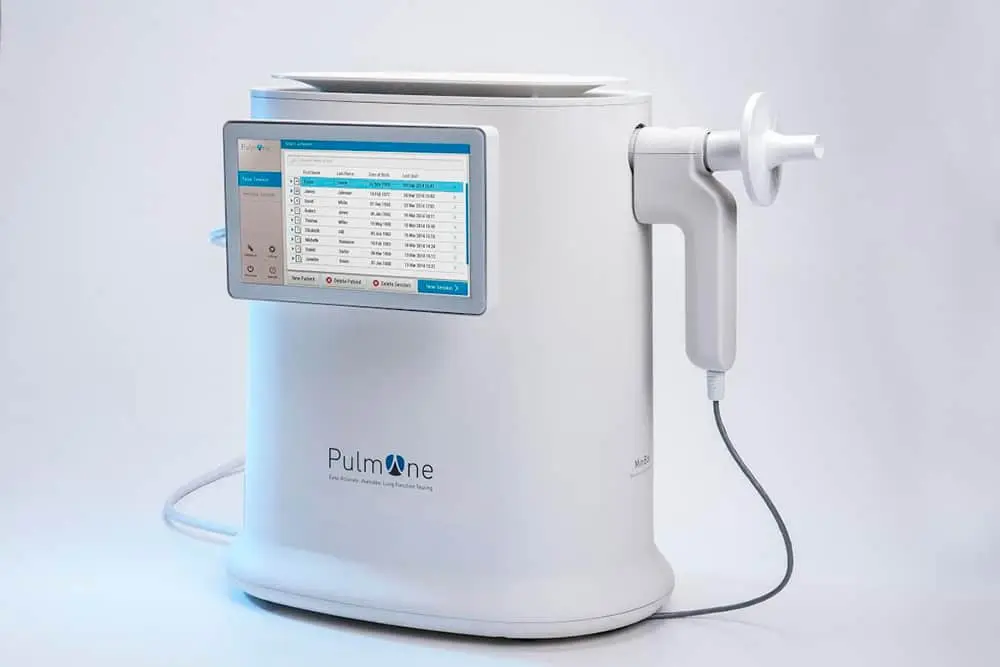
At Australian Polyclinic, DLCO forms part of complete pulmonary function testing when clinically indicated. The PulmOne MiniBox system can combine gas-transfer measurement with spirometry and cabinless lung-volume assessment.
How are DLCO, KCO and VA interpreted?
The laboratory compares the results with appropriate reference values based on characteristics such as age, sex and height. Modern interpretation uses the lower limit of normal and z-scores where appropriate rather than assuming that one fixed percentage—such as 80% predicted—defines normality for everyone.
| Possible pattern | What it may suggest | Important caution |
|---|---|---|
| Low DLCO with low KCO | Impaired transfer efficiency may occur with emphysema, interstitial lung disease, pulmonary vascular disease, anaemia or combined mechanisms. | The PFT pattern does not establish the cause; clinical assessment and other tests are needed. |
| Low DLCO with low VA and preserved or high KCO | Reduced accessible lung volume, incomplete inspiration, loss of lung units, extrapulmonary restriction or uneven ventilation may contribute. | A preserved KCO does not automatically mean that total gas transfer is normal. |
| Low DLCO with relatively preserved spirometry | Early emphysema, pulmonary vascular disease, anaemia or early interstitial disease may be considered, depending on the clinical context. | Normal spirometry does not exclude a clinically important gas-transfer abnormality. |
| High DLCO | Can occur with increased pulmonary blood volume, asthma, obesity, polycythaemia or alveolar haemorrhage, among other situations. | A high result is interpreted with symptoms and other findings; it does not by itself identify a diagnosis. |
Factors that can change the measurement
- Haemoglobin: anaemia can reduce DLCO, while a high haemoglobin level can increase it. Haemoglobin adjustment may be important.
- Smoking and carbon-monoxide exposure: recent smoking can affect the result through raised carboxyhaemoglobin.
- Inspired volume and technique: an incomplete inhalation, leak or poorly timed manoeuvre can produce a misleading value.
- Uneven ventilation: severe airflow obstruction or other lung disease may prevent the tracer gas from reaching all lung regions.
- Supplemental oxygen and altitude: these may require specific preparation or adjustment.
- Recent exercise, body position and other physiological factors: standardised laboratory conditions improve comparability.
This is why the result should be interpreted together with spirometry, lung volumes, symptoms, haemoglobin, imaging and the reason the test was requested.
How should you prepare?
Follow the instructions provided by the laboratory, because preparation may vary with the clinical question. General advice may include:
- Avoid smoking or vaping before the test for the period advised by the laboratory.
- Avoid vigorous exercise shortly before the appointment.
- Avoid a very large meal immediately before testing.
- Wear loose, comfortable clothing.
- Bring a list of medicines, inhalers and any previous PFT reports.
- Tell the laboratory if you use supplemental oxygen.
- Provide a recent haemoglobin result if requested or available.
- Inform the team about recent respiratory infection, coughing of blood, chest pain, pneumothorax, major surgery or an unstable medical condition.
Do not stop prescribed inhalers, oxygen or other medicines unless the referring clinician or PFT laboratory gives you specific instructions.
DLCO testing at Australian Polyclinic Lahore
The Australian Pulmonary Function Laboratory at Australian Polyclinic provides specialist-led pulmonary function testing in DHA Phase 5, Lahore. Depending on the clinical question, assessment may include spirometry, bronchodilator testing, cabinless lung-volume measurement and DLCO.
Tests are performed with attention to technique and quality, and interpreted under the supervision of Dr G Sarwar Chaudhry, an Australian-trained consultant pulmonologist and sleep physician. Not every patient requires a complete PFT; the appropriate components depend on the symptoms, previous findings and referral question.
Frequently asked questions
Are DLCO and TLCO the same test?
Yes. Both describe the overall transfer of carbon monoxide from alveolar gas into pulmonary capillary blood. Different countries and reports may use different terminology.
What is KCO?
KCO is the transfer coefficient calculated from DLCO divided by the alveolar volume measured during the test. It helps interpret how gas transfer relates to the accessible lung volume, but it is not a simple correction that makes a low DLCO normal.
Why might I need DLCO if my spirometry is normal?
Spirometry assesses airflow and forced exhaled volume. DLCO assesses gas transfer. Early emphysema, pulmonary vascular disease, anaemia or some interstitial lung diseases can reduce DLCO even when spirometry is relatively preserved.
Does a low DLCO mean pulmonary fibrosis?
No. Pulmonary fibrosis is one possible explanation, but emphysema, pulmonary vascular disease, anaemia, technical factors and other conditions can also reduce DLCO. The result must be interpreted with the full clinical picture.
Is VA the same as total lung capacity?
Not necessarily. VA is the communicating alveolar volume measured by tracer-gas dilution during the DLCO manoeuvre. Total lung capacity is assessed through a lung-volume method and can differ, particularly when ventilation is uneven or gas is trapped.
Is the carbon monoxide used in the test dangerous?
The diagnostic mixture contains a very small, controlled concentration and the exposure is brief. The test is generally safe when performed according to accepted standards in an appropriate patient.
Can anaemia affect DLCO?
Yes. Because the measurement depends partly on uptake by haemoglobin, anaemia can lower DLCO. Haemoglobin should be considered and, when appropriate, used for adjustment during interpretation.
Is DLCO testing widely available in Pakistan?
It is less widely available than routine spirometry because it needs specialised gas-analysis equipment, quality control and trained interpretation. It is offered at a limited number of comprehensive pulmonary-function centres.
Has your doctor requested a DLCO or complete PFT?
Contact Australian Polyclinic to confirm which test has been requested, whether any preparation is needed and what previous reports you should bring.
First Floor, Building 19, CCA, DHA Phase 5, Lahore · Monday–Saturday, 2:00pm–9:00pm.
Sources and further reading
- Graham BL, et al. 2017 ERS/ATS standards for single-breath carbon monoxide uptake in the lung. European Respiratory Journal.
- Stanojevic S, et al. ERS/ATS technical standard on interpretive strategies for routine lung function tests.
- American Thoracic Society. Pulmonary Function Tests: patient information.
This article provides general educational information and does not replace individual medical assessment, diagnosis or treatment. A DLCO, TLCO or KCO value should not be interpreted in isolation. Seek urgent medical care for severe or rapidly worsening breathlessness, persistent chest pain, fainting, blue lips or another medical emergency.