
Airway testing · Australian Polyclinic · DHA Lahore
Bronchial Challenge Test in Lahore
Asthma symptoms can come and go. When routine spirometry is normal but asthma is still suspected, a supervised hypertonic saline challenge may reveal whether the airways are unusually responsive.
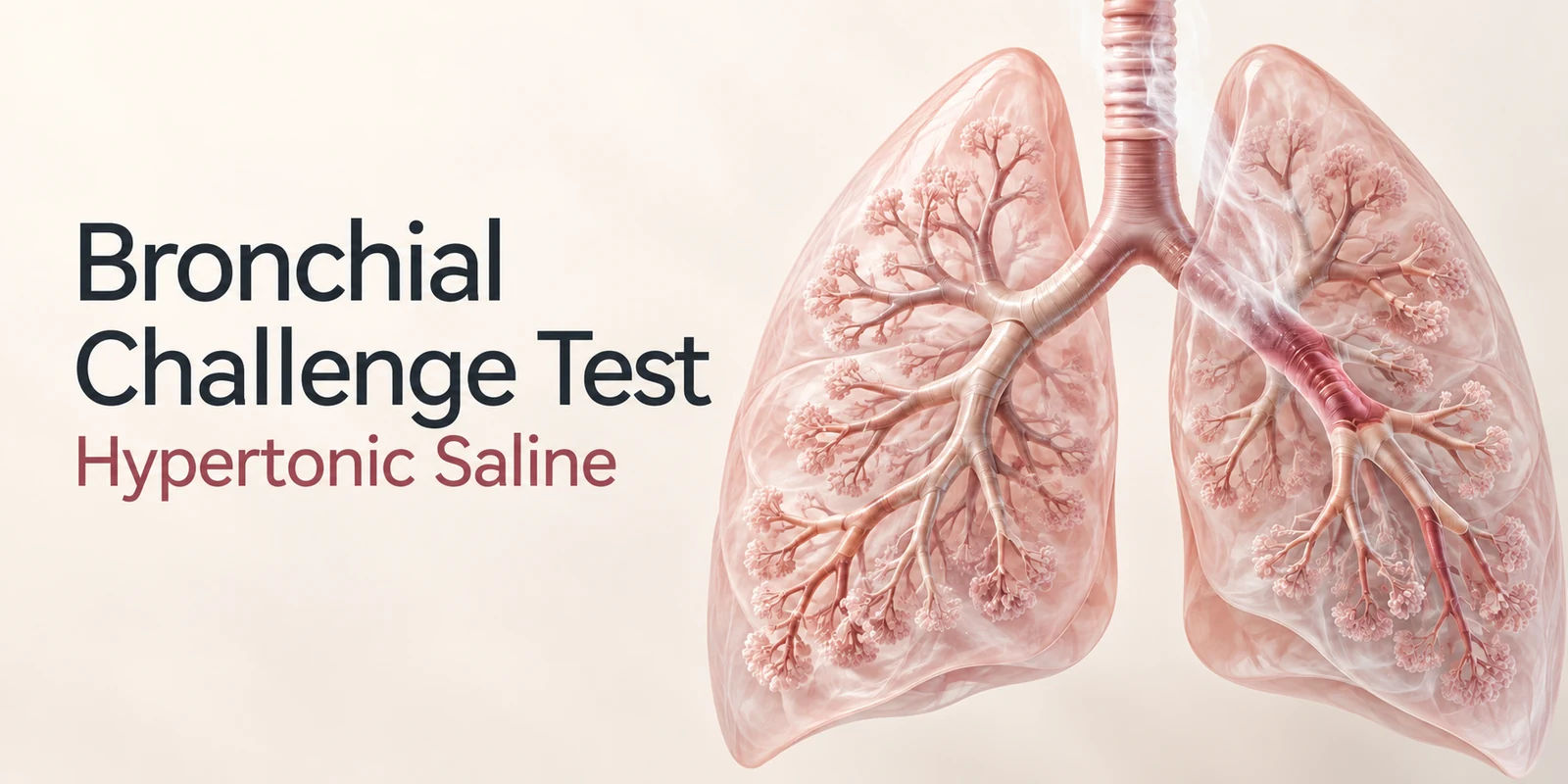
A bronchial challenge test, also called a bronchial provocation test, measures how the airways respond to a controlled stimulus. At Australian Polyclinic, the method used is an inhaled hypertonic saline challenge. Hypertonic saline is a salt solution delivered as a fine mist. Repeated spirometry measurements show whether breathing it in produces a meaningful change in airflow.
The test can be useful when cough, wheeze, chest tightness or breathlessness suggests asthma but baseline lung testing has not answered the question. A clinician first checks whether it is appropriate for that person.
01 / When it may help
Why might a doctor request a bronchial challenge?
Asthma is usually assessed through a history of variable symptoms and objective evidence that airflow varies. But a single spirometry test can be normal between episodes. A bronchial challenge may be considered when:
- There is recurring wheeze, cough, chest tightness or shortness of breath, yet standard spirometry is normal or inconclusive.
- Symptoms occur around exercise, cool or dry air, smoke, dust or other triggers and the cause remains unclear.
- A clinician needs more objective information before confirming or reconsidering an asthma diagnosis.
It is not needed for everyone with suspected asthma. The clinical history, response to spirometry with bronchodilator assessment and other findings guide the choice of test. For the broader pathway, see our asthma assessment page and persistent cough guide.
02 / The procedure
What happens during a hypertonic saline challenge?
This is an indirect airway challenge: the salt mist changes the airway surface environment and can provoke narrowing in sensitive airways. It is different from a treatment nebulisation and different from a methacholine challenge.
Suitability check
Staff review symptoms, current illness, medicines and any relevant medical conditions. If the baseline lung function or clinical situation makes the test unsuitable, it may be deferred.
Baseline spirometry
You take a full breath and then blow hard into a spirometer. This establishes a starting FEV₁, the amount of air breathed out in the first second.
Supervised inhalation
You breathe in nebulised hypertonic saline in stages. Spirometry is repeated between stages while staff check symptoms and the change in FEV₁.
Recovery and review
The challenge stops at the protocol endpoint or earlier if clinically needed. A bronchodilator can be given when indicated, with repeat measurements to check recovery.
The number and length of stages depend on the laboratory protocol and your response. Reception can explain the likely appointment time when arranging the test.
03 / Interpretation
What do positive and negative results mean?
The key measurement is the percentage fall in FEV₁ from the starting value during a standardised challenge. In adults, a fall of 15% or more with hypertonic saline under an appropriate protocol is commonly used as evidence of airway hyperresponsiveness. The clinician also checks test quality, symptoms and the rest of the spirometry trace.
A positive response
Supports unusually responsive airways and can add evidence for asthma in a person with a compatible history. It does not, by itself, prove asthma or identify the cause of symptoms.
A negative response
Means the required fall was not seen under those test conditions. It makes active hyperresponsiveness less likely on that day, but it does not rule out asthma in every situation.
Recent medicines, well-controlled inflammation, the season or timing of symptoms, and whether the full protocol could be completed can affect interpretation. Your doctor combines the result with the clinical history and any other tests.
Important distinction: Hypertonic saline challenge measures airway responsiveness. It is not a skin allergy test, and it cannot tell which pollen, dust mite or food may be involved. If allergy assessment is indicated, read about skin prick testing in Lahore.
04 / Before your visit
How should I prepare?
- Ask for your own medication instructions. Tell the clinic about all inhalers, nebulisers, tablets and other medicines. Some treatments can change the result, but the safe withholding period varies. Do not stop a preventer, rescue inhaler, steroid or other prescribed treatment without your clinician’s direction.
- Tell us if your breathing has worsened. Report a recent flare, respiratory infection, fever, emergency visit or increased need for reliever treatment before travelling to the clinic; the test may need to be postponed.
- Bring useful information. Bring your referral or clinical request, medicine list and previous spirometry or lung function reports, if available.
- Follow the booking instructions. Staff will advise on smoking or vaping, vigorous exercise, food and drink before the appointment according to your test plan.
Tests are arranged by indication and suitability, so contact the clinic for the current appointment availability and instructions.
05 / Safety
Is a bronchial challenge test safe?
The test intentionally looks for airway narrowing, so temporary cough, wheeze, tightness or breathlessness can occur. The team monitors symptoms and repeated spirometry, stops the challenge if required and has bronchodilator treatment available. You should tell staff immediately if you feel unwell at any point.
A challenge may be unsuitable or delayed in someone with significant baseline airflow limitation, a current exacerbation or infection, or another medical condition that makes forced breathing or provoked airway narrowing unsafe. Screening is individual; your clinician decides whether and when to proceed.
If you have severe or rapidly worsening breathing difficulty, seek urgent medical care rather than waiting for an elective test.
06 / Common questions
Frequently asked questions
Can I have asthma if my ordinary spirometry is normal?
Yes. Airflow in asthma can vary, and spirometry may be normal between symptomatic episodes. Your doctor may consider repeat testing, bronchodilator assessment, peak-flow monitoring or a bronchial challenge when the diagnosis remains uncertain.
Does a positive hypertonic saline challenge mean I definitely have asthma?
No. A positive test shows airway hyperresponsiveness under the test conditions. It supports an asthma diagnosis when the symptoms and other findings fit, but it is not a stand-alone diagnosis.
Does a negative bronchial challenge rule out asthma?
Not always. A negative result means the required fall in FEV₁ was not seen during that test. Current treatment, timing and whether the full protocol was completed can affect the result, so your clinician interprets it with your history.
Do I need to stop my inhalers before the test?
Some medicines may need to be withheld for a specific period, but instructions depend on the medicine and your health. Do not stop a prescribed inhaler or other treatment until the clinician arranging your test tells you exactly what to do.
Will the saline cause an asthma attack?
The aim is to measure whether the airways narrow in a controlled setting. You may cough or feel temporary tightness or wheeze. Staff monitor you, stop the test if needed and can give a bronchodilator to help your breathing recover.
Is hypertonic saline challenge the same as a methacholine challenge?
No. Hypertonic saline is an indirect osmotic challenge, whereas methacholine acts directly on airway smooth muscle. Both assess airway responsiveness, but their methods and interpretation differ. Australian Polyclinic uses a hypertonic saline challenge.
Can I have the test during a chest infection or asthma flare?
Tell the clinic before attending if you have a recent respiratory infection or worsening breathing. The clinician may postpone the challenge until it is safer and the result is more useful.
How long will the test take?
The appointment includes screening, baseline spirometry, staged inhalation, repeat measurements and recovery. The total time varies with your response and the protocol; ask the clinic when booking.
Want to understand asthma better? Read our patient guide to asthma symptoms, diagnosis and treatment, including breathing tests, inhalers and when to seek urgent care.
Australian Polyclinic · DHA Phase 5, Lahore
Discuss whether bronchial challenge is right for you
Dr G Sarwar Chaudhry, MBBS, FRACP (Australia), FCCP (USA), reviews respiratory symptoms and selects testing according to the clinical question. Bring previous lung tests and your current medication list.
First Floor, Building 19, CCA, DHA Phase 5, Lahore · Clinic Monday–Saturday, 2–9 pm · Dr Sarwar consultations, 4–8 pm. Test appointments require confirmation.
Clinical references
- Global Initiative for Asthma (GINA), 2026 Strategy Report — diagnostic approach and challenge thresholds.
- European Respiratory Society, 2018 indirect airway challenge technical standard — methods, preparation and interpretation.
- Australian Asthma Handbook, lung function tests — role of bronchial provocation alongside spirometry.
Patient information only; individual suitability, preparation and treatment must be decided by the treating clinician. Meet Dr G Sarwar Chaudhry.