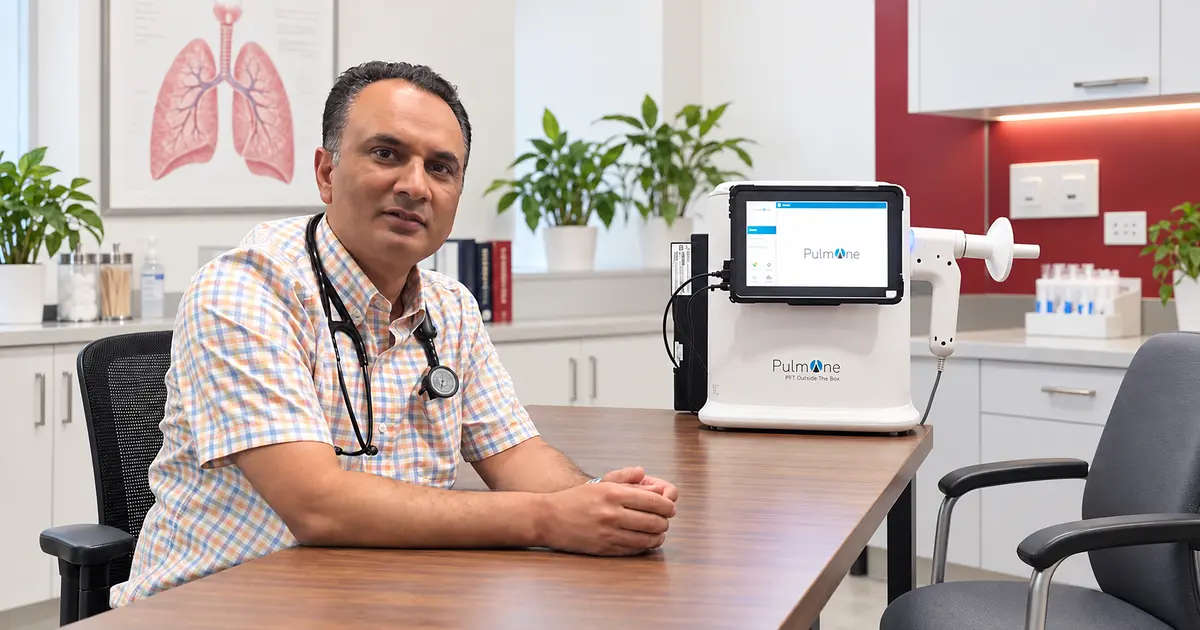
THE LABORATORYDetailed lung-function testing with specialist interpretation
The Australian Pulmonary Function Laboratory (APFL) at Australian Polyclinic, DHA Phase 5, Lahore provides detailed assessment of airflow, lung volumes and gas transfer. Testing is selected according to the patient’s symptoms, medical history and the clinical question from the treating or referring doctor.
Pulmonary function tests can help investigate breathlessness, persistent cough, wheezing, reduced exercise capacity and abnormal chest imaging. They are also used to assess or monitor conditions such as asthma, COPD, bronchiectasis, emphysema, interstitial lung disease and respiratory problems following tuberculosis.
Not every patient requires every component of a complete PFT. Our staff can help confirm which tests have been requested and provide individual preparation instructions, including whether any inhalers need to be withheld before the appointment.
Want a fuller explanation of what the measurements mean? Read our patient guide to pulmonary function testing (PFT) in Lahore →.
LUNG FUNCTIONPulmonary function tests available at APFL
Different tests examine different parts of lung function. The appropriate combination depends on whether the clinical question concerns airflow obstruction, bronchodilator response, reduced lung capacity, air trapping or impaired gas transfer.
Spirometry and bronchodilator response
Spirometry measures how much air can be forcibly breathed out and how quickly it leaves the lungs. When indicated, the test is repeated after an inhaled bronchodilator to assess whether airflow measurements improve.
Learn about spirometry →
Lung-volume measurement
Lung-volume testing measures total lung capacity (TLC), residual volume (RV) and other volumes that ordinary spirometry cannot directly assess. It can help confirm restriction and identify air trapping or hyperinflation.
Learn about lung-volume testing →
DLCO or gas-transfer testing
DLCO estimates how effectively gas passes from the air sacs of the lungs into the bloodstream. It may provide useful information in emphysema, interstitial lung disease, pulmonary vascular disease and other clinical situations.
Learn about DLCO →
Complete pulmonary function testing
A complete PFT combines spirometry with lung-volume measurement and DLCO. Bronchodilator-response testing may be added when clinically indicated. Together, these measurements provide a broader physiological assessment than spirometry alone.
Read the complete PFT patient guide →
RELATED ASSESSMENTSAdditional assessments available through Australian Polyclinic
The following are not all components of a routine PFT, but they may be requested separately when relevant to the patient’s symptoms or diagnosis.
Bronchial challenge testing
Bronchial challenge testing may help assess airway hyperresponsiveness when asthma remains suspected despite normal or inconclusive baseline spirometry. It is arranged separately after clinical assessment.
Learn about bronchial challenge testing →
Six-minute walk test
The six-minute walk test assesses functional walking capacity, symptoms and oxygen saturation during a standardised period of exertion.
Learn about the six-minute walk test →
Arterial blood gas analysis
An arterial blood gas (ABG) measures oxygen, carbon dioxide and acid–base status in an arterial blood sample. It is a separate investigation rather than a breathing manoeuvre.
Learn about arterial blood gas testing →
Skin-prick aeroallergen testing
Skin-prick testing can help identify sensitisation to relevant airborne allergens when allergic asthma or allergic rhinitis is suspected. It is an allergy assessment and not part of a pulmonary function test.
Learn about aeroallergen testing →
WHEN TO TESTWho may need pulmonary function testing?
A doctor may recommend spirometry or complete pulmonary function testing to investigate symptoms, clarify a suspected physiological abnormality, establish a baseline or monitor change over time.
- Persistent or unexplained shortness of breath
- Recurrent wheeze or chest tightness
- Chronic or recurring cough
- Reduced exercise capacity
- Suspected or established asthma
- Smoking-related symptoms, COPD or emphysema
- Bronchiectasis
- Interstitial lung disease or pulmonary fibrosis
- Previous tuberculosis with ongoing respiratory symptoms
- Occupational exposure to dust, fumes or chemicals
- Abnormal chest imaging
- Monitoring an established lung condition or response to treatment
- Preoperative respiratory assessment when clinically indicated
The test demonstrates a physiological pattern; it does not determine the diagnosis by itself. Results are most useful when interpreted alongside the patient’s symptoms, examination, medical history, imaging and other investigations.
YOUR APPOINTMENTWhat should I expect during the appointment?
Pulmonary function testing is non-invasive and should not be painful. Forceful breathing can occasionally cause temporary coughing, light-headedness, chest tightness or tiredness. You can pause and recover between manoeuvres.
Preparation and explanation
Your age, height and other relevant information are recorded because results are compared with appropriate reference values. A staff member explains and demonstrates each breathing manoeuvre.
Filtered mouthpiece and nose clip
Testing is performed through a clean mouthpiece with a single-use bacterial and viral filter. A nose clip may be used to ensure that air passes through the mouthpiece.
Repeated breathing manoeuvres
You may be asked to breathe normally, inhale fully, exhale forcefully or briefly hold your breath, depending on the tests requested. Several attempts may be needed to achieve consistent and technically reliable results.
Additional testing when requested
Spirometry may be repeated after a bronchodilator. Lung-volume and DLCO measurements may also be performed as part of a complete PFT.
BEFORE YOU ARRIVEHow should I prepare for a PFT?
Follow the individual instructions provided by the laboratory or referring doctor. General preparation may include:
- Wear loose, comfortable clothing
- Avoid a large meal immediately before testing
- Avoid smoking or vaping before the appointment
- Avoid vigorous exercise shortly before testing
- Bring a list of your medicines and inhalers
- Bring previous PFT reports, chest imaging and relevant medical records
- Tell the staff if you have recently had a respiratory infection
- Arrive with enough time to rest before testing
Do not stop prescribed inhalers or other medicines unless the clinic or referring doctor has specifically instructed you to do so. Whether an inhaler should be withheld depends on the medication and the purpose of testing.
PATIENT COMFORTIs pulmonary function testing safe?
Pulmonary function testing is generally safe and non-invasive. However, forceful breathing temporarily increases pressure inside the chest, abdomen and eyes.
Before testing, tell the clinic if you have recently experienced a heart attack, stroke, unstable heart problem, collapsed lung, significant coughing of blood or a severe respiratory infection. You should also inform staff about recent chest, abdominal, brain or eye surgery, uncontrolled high blood pressure, severe chest pain, fainting or acute breathlessness.
These circumstances do not automatically prevent testing. The clinician will determine whether the assessment should proceed, be modified or be postponed.
SPECIALIST CAREWhy test quality and specialist interpretation matter
Reliable pulmonary function testing depends on appropriate equipment, quality-control procedures, infection-control measures, patient effort, careful coaching and suitable reference values. The report must then be interpreted in relation to the reason for testing.
At APFL, results are reviewed under the supervision of Dr G Sarwar Chaudhry →, MBBS, FRACP (Australia), FCCP (USA), an Australian-trained consultant pulmonologist and sleep physician with experience in detailed pulmonary function testing and complex respiratory assessment.
Where requested, results can be provided to the patient and referring doctor to support ongoing clinical management. A PFT report should be interpreted by the treating clinician and should not be used as a stand-alone diagnosis.
Clinic staff can also provide practical education on inhaler technique, spacer use, nebuliser use and breathing exercises when clinically appropriate.
YOUR QUESTIONSFrequently asked questions
What is the difference between spirometry and a complete PFT?
Spirometry measures airflow and the amount of air forcibly exhaled. A complete PFT usually adds lung-volume measurement and DLCO to assess total lung capacity, air trapping and gas transfer. Bronchodilator-response testing may also be included when indicated.
How long does pulmonary function testing take?
Simple spirometry may take approximately 15–30 minutes. Complete testing can take longer, particularly when lung volumes, DLCO or post-bronchodilator spirometry are required. The total time also depends on how many repeat manoeuvres are needed to obtain reliable results.
Is a pulmonary function test painful?
No. The tests are non-invasive and should not be painful. Forceful breathing can briefly cause coughing, light-headedness, chest tightness or tiredness, and rest can be provided between attempts.
Should I stop my inhalers before the test?
Do not stop an inhaler unless the clinic or referring doctor specifically instructs you to do so. Advice varies according to the medication and whether the test is intended to assess your usual treated lung function or bronchodilator responsiveness.
Do I need a doctor’s referral?
A referring doctor can specify the clinical question and tests required. If you do not have a referral or are uncertain which test is appropriate, contact the clinic before booking so that the most suitable pathway can be discussed.
Can a normal PFT exclude asthma?
No. Asthma is variable, and spirometry may be normal when symptoms are absent or well controlled. Depending on the clinical situation, further assessment may include repeat spirometry, peak-flow monitoring or separately arranged bronchial challenge testing.
Can children perform pulmonary function testing?
Many school-aged children can perform spirometry if they can understand and follow the breathing instructions. Suitability for complete testing depends on the child’s age, cooperation and the clinical question.
How will I receive my results?
The results are checked for technical quality and interpreted in relation to the requested assessment. They can then be provided to you and, where requested, to your referring doctor. Ask the clinic about the expected reporting arrangements for your appointment.
Where is APFL located?
The Australian Pulmonary Function Laboratory operates through Australian Polyclinic, First Floor, Building 19, CCA, DHA Phase 5, Lahore. Call or WhatsApp 0311 057 3333 to discuss testing and arrange an appointment.
BOOK AN APPOINTMENTArrange pulmonary function testing in Lahore
The appropriate test depends on the symptoms and the clinical question. Some patients require spirometry alone, while others need bronchodilator assessment or a complete PFT with lung volumes and DLCO.
Contact Australian Polyclinic before your appointment if you need guidance about the requested test or instructions regarding inhaler therapy.
Call or WhatsApp: 0311 057 3333
First Floor, Building 19, CCA, DHA Phase 5, Lahore
Monday–Saturday, 2:00pm–9:00pm
Book by WhatsApp Call the clinic This page provides general medical information and does not replace individual consultation, examination, diagnosis or treatment.