

Written by the Australian Polyclinic Medical Team
Article reviewed and approved by Dr G Sarwar Chaudhry, MBBS, FRACP (Australia), FCCP (USA) — Consultant Pulmonologist, Sleep Physician and Allergy Specialist.
Breathlessness, recurring cough, wheezing and reduced exercise capacity can have many possible causes. Symptoms alone do not always show whether the problem arises from narrowed airways, reduced lung capacity, impaired transfer of oxygen or a condition outside the lungs.
A pulmonary function test in Lahore can provide objective information about how the lungs are working. Depending on the clinical question, testing may include spirometry, assessment before and after a bronchodilator, measurement of lung volumes and diffusion capacity, commonly called DLCO.
At the Australian Pulmonary Function Laboratory in DHA Phase 5, pulmonary function testing is selected according to the patient’s symptoms and clinical indication. Not every patient requires every component of a complete PFT.
What Is a Pulmonary Function Test?
Pulmonary function tests, often abbreviated to PFTs, are a group of breathing tests used to measure different aspects of lung function.
These tests can help assess:
- How much air a person can breathe in and out
- How quickly air can be expelled from the lungs
- Whether the airways are narrowed or obstructed
- Whether the total capacity of the lungs is reduced
- Whether air becomes trapped inside the lungs
- How effectively gas passes from the lungs into the bloodstream
- Whether lung function changes after an inhaled bronchodilator
A PFT result is interpreted using the patient’s age, sex, height and other relevant clinical information. It should not be judged from a single number or percentage alone.
The results are most useful when considered alongside symptoms, examination, medical history, previous imaging and other investigations.
Is Spirometry the Same as a Complete PFT?
Spirometry is an important part of pulmonary function testing, but it is not the same as a complete PFT.
Spirometry
Spirometry measures the volume and speed of air that a person can forcibly breathe out. Important measurements include:
- FEV₁: the volume of air expelled during the first second of a forceful breath
- FVC: the total volume expelled during the complete forced breath
- FEV₁/FVC ratio: the proportion of the total breath expelled in the first second
These measurements help identify airflow obstruction and assess its severity. Obstructive patterns can occur in conditions such as asthma and chronic obstructive pulmonary disease, although the results must always be interpreted in clinical context.
Complete pulmonary function testing
A complete PFT usually provides more information by combining:
- Spirometry
- Bronchodilator response testing when indicated
- Lung-volume measurements
- Diffusion or gas-transfer measurement, known as DLCO
This broader assessment may be helpful when symptoms cannot be adequately explained by basic spirometry or when restrictive lung disease, emphysema, air trapping or impaired gas transfer is suspected.
What Does Spirometry Show?
During spirometry, the patient takes the deepest possible breath and then blows into a filtered mouthpiece as hard, fast and completely as possible.
The manoeuvre is normally repeated because consistent efforts are required to produce a reliable result. Coaching by trained staff is an important part of accurate testing.
Spirometry can help identify an obstructive ventilatory pattern, in which air has difficulty leaving the lungs. This may occur in asthma, COPD, bronchiectasis and some other airway disorders.
A reduced FVC can raise the possibility of a restrictive pattern, but spirometry alone cannot confirm restriction. A low FVC may also result from air trapping, incomplete inhalation, early termination of the manoeuvre or other technical and clinical factors. Lung-volume measurement is required to determine whether total lung capacity is genuinely reduced.
What Is Bronchodilator Reversibility Testing?
When clinically indicated, spirometry may be repeated after the patient inhales a bronchodilator medicine.
The purpose is to assess whether airflow measurements improve after the airways have been relaxed. A significant response can support the presence of variable airflow obstruction, but the result does not diagnose or exclude asthma by itself.
Asthma can vary from day to day. Some people with asthma have normal spirometry when they are well or when their condition is controlled by treatment. Conversely, a response to a bronchodilator may occasionally occur in other airway conditions.
If asthma remains suspected despite normal spirometry, further clinical evaluation may include peak-flow monitoring or a separately arranged bronchial challenge test. You can learn more from our guide to asthma assessment and treatment in Lahore.
What Do Lung-Volume Measurements Show?
Lung-volume testing measures air that cannot be fully assessed through ordinary spirometry.
Important measurements may include:
- Total lung capacity (TLC): the total amount of air in the lungs after the deepest possible breath
- Residual volume (RV): the air remaining after breathing out as completely as possible
- Functional residual capacity (FRC): the volume remaining in the lungs after a normal, relaxed breath out
These measurements can help identify:
Restriction
A reduced total lung capacity confirms a restrictive ventilatory defect. This pattern may occur in interstitial lung disease, chest-wall disorders, neuromuscular weakness, obesity and several other conditions.
The PFT demonstrates the physiological pattern; it does not determine the cause by itself.
Air trapping
An increased residual volume can indicate that air remains trapped inside the lungs after expiration. Air trapping may occur in asthma, COPD and small-airway disease.
Hyperinflation
Some obstructive lung diseases cause lung volumes to increase because the lungs do not empty normally. This can contribute to breathlessness and reduced exercise tolerance.
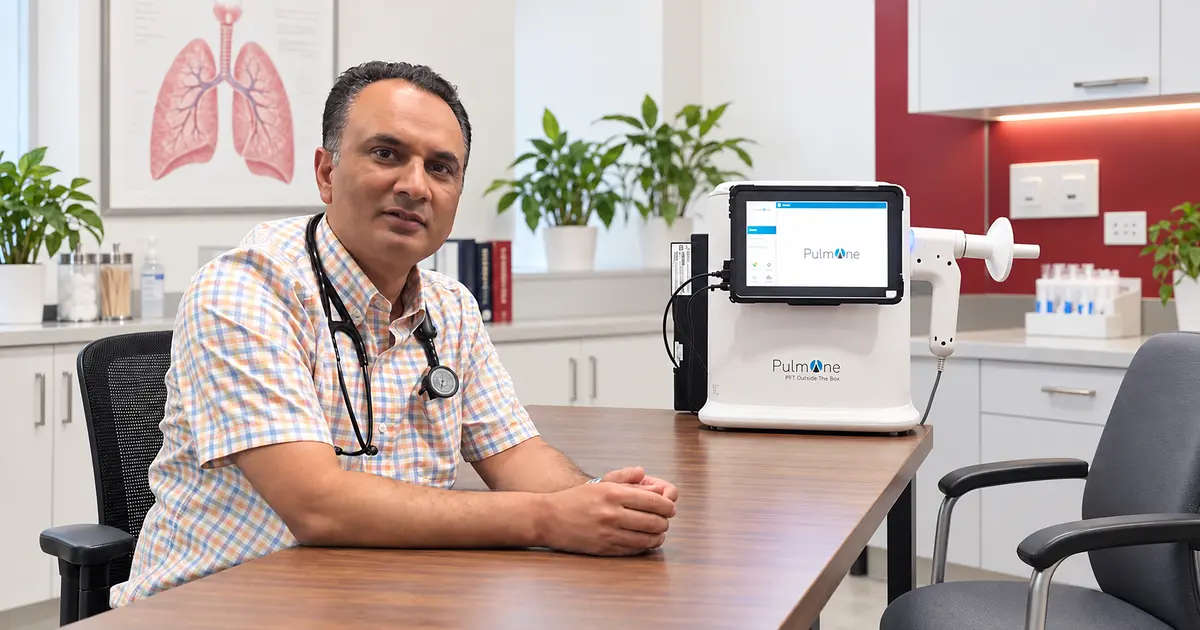
Australian Polyclinic uses a compact, cabinless PulmOne MiniBox system for complete pulmonary function testing. It can measure lung volumes without requiring the patient to sit inside a traditional sealed body-plethysmography chamber.
What Is a DLCO Test?
DLCO stands for diffusing capacity of the lungs for carbon monoxide. It is also called a gas-transfer test.
During the test, the patient inhales a diagnostic test-gas mixture, holds the breath briefly and then breathes out. The amount of gas absorbed is used to estimate how effectively gas moves from the air sacs of the lungs into the bloodstream.
A reduced DLCO can occur in conditions such as:
- Emphysema
- Interstitial lung disease or pulmonary fibrosis
- Pulmonary vascular disease
- Anaemia
- Some combinations of airway and lung-tissue disease
DLCO can also be affected by haemoglobin level, smoking, lung volume and the quality of the test manoeuvre. A low result is therefore not a diagnosis by itself.
When appropriate, haemoglobin concentration and other clinical factors should be considered during interpretation.
Who May Need Pulmonary Function Testing?
A doctor may recommend spirometry or complete pulmonary function testing for someone with:
- Persistent or unexplained shortness of breath
- Recurrent wheezing
- Chronic or recurring cough
- Chest tightness
- Reduced exercise capacity
- Suspected or established asthma
- Smoking-related respiratory symptoms
- Suspected COPD or emphysema
- Bronchiectasis
- Interstitial lung disease or pulmonary fibrosis
- Previous tuberculosis with residual respiratory symptoms
- Occupational exposure to dust, fumes or chemicals
- Abnormal chest imaging
- Possible respiratory muscle weakness
- A need to monitor an established lung condition
- A need to assess response to treatment
- A preoperative respiratory assessment when clinically indicated
PFTs may also be requested before or during treatment with certain medicines that can affect the lungs.
If cough is the main concern, read our guide to the causes and assessment of persistent cough in Lahore.
What Can a PFT Result Mean?
A PFT report may describe one or more physiological patterns.
Obstructive pattern
An obstructive pattern means airflow out of the lungs is reduced. The clinical possibilities include asthma, COPD, bronchiectasis and other airway disorders.
Restrictive pattern
True restriction means total lung capacity is reduced. Further assessment is required to identify whether this is related to lung tissue, the chest wall, obesity, respiratory muscles or another cause.
Mixed pattern
Some patients have evidence of both airflow obstruction and reduced lung capacity. Complete testing helps distinguish a genuine mixed abnormality from obstruction accompanied by air trapping.
Reduced gas transfer
A reduced DLCO suggests impaired transfer of gas from the lungs into the blood, but the possible explanation depends on spirometry, lung volumes, haemoglobin, imaging and the wider clinical picture.
Normal pulmonary function
Normal results can be reassuring, but they do not exclude every respiratory disorder. Asthma can be intermittent, some early lung conditions may not cause obvious abnormalities, and breathlessness may arise from cardiac disease, anaemia, deconditioning or other causes.
PFT findings must therefore be interpreted in context rather than used as a stand-alone diagnosis.
What Happens During the Test?
The exact sequence depends on which tests have been requested.
1. Basic information is recorded
Your height, age and other relevant details are entered because lung-function results are compared with appropriate reference values.
2. The procedure is explained
A staff member demonstrates the required breathing manoeuvres. Good coaching and repeatable effort are essential for a reliable test.
3. A nose clip and filtered mouthpiece are used
The nose clip directs breathing through the mouth. A clean mouthpiece with a single-use bacterial and viral filter is used.
4. Spirometry is performed
You will usually take a full breath in and then blow out as hard, fast and completely as possible. Several attempts may be needed.
5. A bronchodilator may be given
If bronchodilator testing has been requested, you will inhale the medicine, wait for the required interval and then repeat spirometry.
6. Lung volumes may be measured
This generally involves a period of controlled or relaxed breathing through the mouthpiece.
7. DLCO may be measured
You will inhale the test gas, hold your breath for a short period and then breathe out according to the staff member’s instructions.
The tests should not be painful. Forceful breathing can temporarily cause coughing, light-headedness, chest tightness or tiredness. You can pause and recover between manoeuvres.
How Long Does a PFT Take?
Simple spirometry may take approximately 15–30 minutes. A complete PFT with spirometry, lung volumes, DLCO and bronchodilator assessment can take longer.
The total time varies according to the tests requested, the need for repeat manoeuvres and whether a bronchodilator is administered. Accurate, repeatable results are more important than completing the test quickly.
How Should I Prepare?
Follow the individual instructions given by the laboratory or referring doctor.
General preparation may include:
- Wear loose, comfortable clothing
- Avoid a large meal immediately before testing
- Avoid smoking or vaping before the appointment
- Avoid vigorous exercise shortly before the test
- Bring a list of your current medicines and inhalers
- Bring previous PFT reports, chest imaging and relevant medical records
- Tell the staff if you have recently had a respiratory infection
- Arrive with enough time to rest before testing
Do not stop prescribed inhalers or other medicines unless the clinic or referring doctor has specifically instructed you to do so. Whether inhalers should be withheld depends on the purpose of the test and the medicines being used.
Is Pulmonary Function Testing Safe?
Pulmonary function testing is generally safe and non-invasive. However, forced breathing temporarily increases pressure inside the chest, abdomen and eyes.
Before testing, inform the clinic if you have recently experienced or undergone:
- A heart attack, stroke or unstable heart problem
- Chest, abdominal, brain or eye surgery
- A collapsed lung
- Significant coughing of blood
- A severe respiratory infection
- Uncontrolled high blood pressure
- Severe chest pain, fainting or acute breathlessness
This does not automatically mean testing cannot be performed. The clinician will determine whether the test should proceed, be modified or be postponed.
Why Test Quality and Specialist Interpretation Matter
PFT results depend on several factors, including equipment quality, calibration, infection-control procedures, patient effort, staff coaching and appropriate reference values.
The printed report must then be interpreted in relation to the clinical question. The same numerical abnormality can have different implications in different patients.
At Australian Polyclinic, pulmonary function testing is performed through the Australian Pulmonary Function Laboratory, with specialist interpretation under the supervision of Dr G Sarwar Chaudhry, an Australian-trained consultant pulmonologist and sleep physician experienced in complex lung-function testing.
Frequently Asked Questions
What is the difference between spirometry and a complete PFT?
Spirometry measures airflow and the amount of air forcibly exhaled. A complete PFT may add lung-volume measurement and DLCO to assess total lung capacity, air trapping and gas transfer.
Is a pulmonary function test painful?
No. PFTs are non-invasive and should not be painful. Forceful breathing may briefly cause coughing, light-headedness or tiredness, and rest can be provided between attempts.
How long does pulmonary function testing take?
Simple spirometry may take approximately 15–30 minutes. Complete testing can take longer, particularly when lung volumes, DLCO or post-bronchodilator spirometry are required.
Should I stop my inhalers before a PFT?
Do not stop an inhaler unless specifically instructed. The advice depends on the medicine and whether the test is intended to assess your usual lung function or your response without bronchodilator treatment.
Can a normal PFT exclude asthma?
No. Asthma is variable, and lung function may be normal when symptoms are absent or well controlled. Further assessment may sometimes include repeat spirometry, peak-flow monitoring or bronchial challenge testing.
What does a DLCO test measure?
DLCO estimates how effectively gas moves from the air sacs of the lungs into the bloodstream. It can provide useful information in emphysema, interstitial lung disease, pulmonary vascular disease and other conditions.
Can children undergo pulmonary function testing?
Many school-aged children can perform spirometry successfully if they can understand and follow the breathing instructions. Suitability for complete testing depends on the child’s age, cooperation and the clinical question.
Where can I have a pulmonary function test in Lahore?
Pulmonary function testing is available at Australian Polyclinic, First Floor, Building 19, CCA, DHA Phase 5, Lahore. Call or WhatsApp 0311 057 3333 to discuss the appropriate test and arrange an appointment.
Book Pulmonary Function Testing in Lahore
The appropriate test depends on your symptoms and the clinical question. Some patients need spirometry alone, while others require bronchodilator assessment or a complete PFT with lung volumes and DLCO.
To arrange testing at the Australian Pulmonary Function Laboratory, Australian Polyclinic, call or WhatsApp:
0311 057 3333
First Floor, Building 19, CCA, DHA Phase 5, Lahore
Monday–Saturday, 2:00pm–9:00pm
Explore the Australian Pulmonary Function Laboratory
This article provides general medical information and does not replace individual consultation, examination, diagnosis or treatment.