
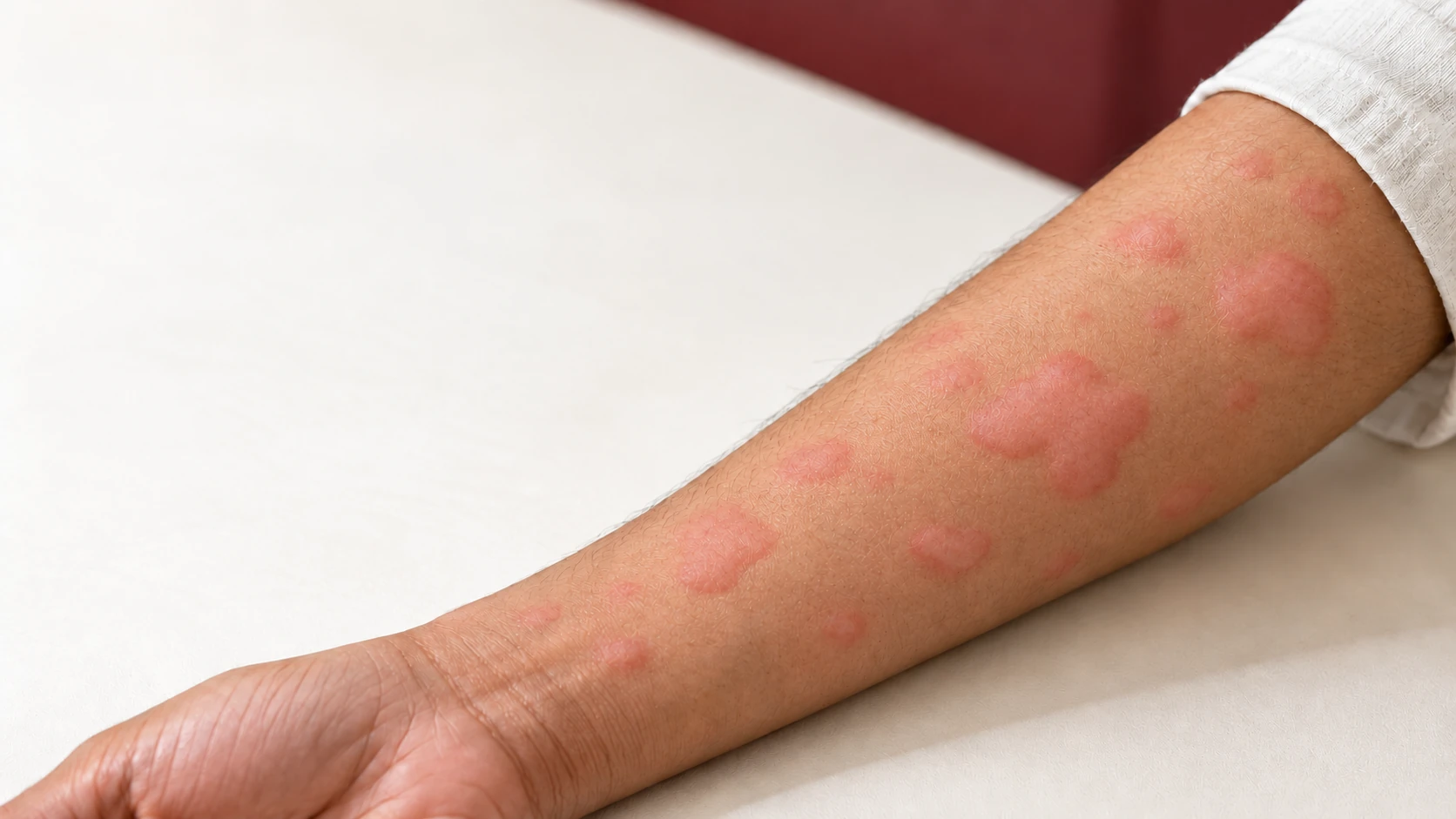
When hives keep appearing, an “allergy test for everything” can sound like the fastest route to an answer. In practice, the useful test depends on the question being asked.
This guide explains the difference between testing for a suspected allergic reaction and assessing urticaria itself. For symptoms, causes and treatment, read the main urticaria guide. For a personal assessment, start with Dr Sadaf’s skin allergy service.
Why does the history come before the test?
The doctor needs to know when the rash began, how quickly it followed a suspected exposure, whether the same pattern has happened again and whether there were symptoms beyond the skin. Photographs and a timeline can be more informative than an untargeted panel.
Acute hives sometimes have an allergic trigger. In chronic spontaneous urticaria, routine skin prick or specific-IgE testing is generally not recommended simply to search for the cause. Tests can detect unrelated sensitisation and complicate the picture.[1]
When might targeted allergy testing help?
Testing may be useful when the history suggests a particular immediate reaction—for example, reproducible hives after a specific food or exposure, especially with other allergic symptoms. The clinician chooses the suspected allergen and decides how the result will influence advice.[2]
Testing does not replace emergency care. Sudden swelling of the lips, mouth, tongue or throat, breathing or swallowing difficulty, faintness or collapse needs urgent emergency assessment rather than a routine testing appointment.[5]
Skin prick tests, IgE blood tests and patch tests answer different questions
| Test | Main purpose | Important limit |
|---|---|---|
| Skin prick testing | Assesses immediate sensitisation to selected allergens. | Must fit the history; some medicines affect the skin response. |
| Allergen-specific IgE blood testing | Measures IgE directed against a particular allergen. | A positive result alone does not prove a clinical allergy. |
| Patch testing | Investigates suspected delayed allergic contact dermatitis. | It answers a different question from routine hives assessment. |
The appropriate method depends on the suspected condition and individual circumstances. Not every rash needs all three methods.[2][4]
Does a positive result mean that food caused my hives?
Not necessarily. A positive test can show sensitisation without establishing that exposure causes symptoms. Clinicians interpret the result alongside the reaction history, the type of test and other findings.[2]
Ask what would change in your care if the result were positive or negative. Avoid removing foods solely because they appear on a panel. If a supervised challenge is needed to clarify a suspected food reaction, this requires an appropriate specialist setting; it is not a home experiment.
Why are IgG “food intolerance” panels different?
Food-specific IgG panels are not validated tests for diagnosing food allergy or explaining chronic hives. IgG antibodies can reflect ordinary exposure to a food, and some IgG responses may be associated with tolerance rather than disease.
Using these results to prescribe a long list of exclusions can lead to unnecessary cost and restrictive diets. Professional allergy organisations advise against using IgG food testing to diagnose food allergy or intolerance.[3]
Why might a doctor order blood tests that are not allergy tests?
A urticaria assessment and an allergy investigation are not the same thing. A clinician may consider selected general blood tests when persistent symptoms or the history suggest an associated condition. Specialist investigations may have other purposes, such as helping guide treatment.[1]
More tests do not automatically mean a more complete diagnosis. The goal is to choose investigations with a clear clinical purpose, then explain what the findings do and do not establish.
How should you prepare for a consultation or planned test?
- Bring photographs and note how long individual patches last.
- List the suspected exposures and the interval before symptoms.
- Include all medicines, supplements and previous treatment.
- Bring old reports to avoid unnecessary repetition.
- Tell the clinic about any previous severe reaction.
If a skin test is planned, ask for individual preparation instructions. Antihistamines can interfere with the skin response. Do not stop essential prescribed treatment on your own.[2]
There is no need to obtain a panel before your first visit. A consultation can establish which investigation, if any, would be useful.
Testing and skin allergy care at Australian Polyclinic
Dr Sadaf Sarwar assesses and manages urticaria and skin allergy concerns at Australian Polyclinic, DHA Phase 5, Lahore. Testing is considered in the context of the symptoms and suspected diagnosis.
The clinic provides skin prick testing when appropriate. Your clinician can advise about external laboratory testing if allergen-specific IgE blood tests are needed. Do not assume that a discussion of patch testing or supervised food challenge means those services are performed at the clinic.
Explore the skin prick allergy testing guide, the urticaria care service, and the Allergy Centre. If recurring hives are the main issue, this chronic urticaria article explains why symptom control and follow-up often matter more than another panel.