
An itchy rash that changes over the day can be unsettling. A patch disappears from your arm, another appears on your back, and you begin wondering whether a food, medicine or skin product is responsible.
Urticaria is the medical name for hives. This guide explains the pattern, what investigations can and cannot tell you, and how treatment is usually approached. For an individual assessment in Lahore, explore urticaria and skin allergy care with Dr Sadaf Sarwar.
What is urticaria, and what do hives look like?
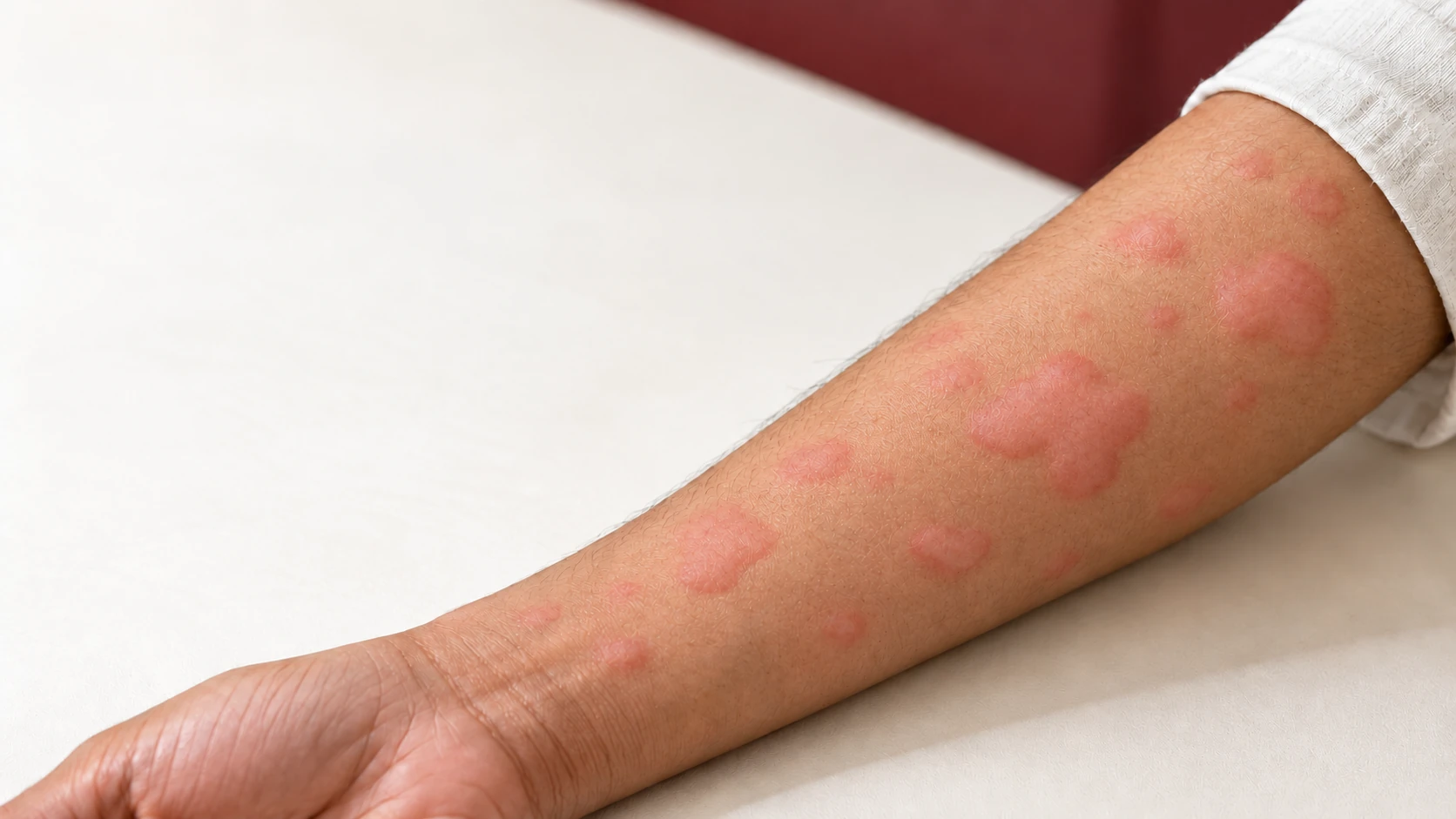
Hives are temporary swellings in the skin called wheals. They usually itch, vary in shape and size, and may merge into larger areas. Their colour can be pink, red, purple-brown or similar to the surrounding skin, depending on skin tone. Histamine and other chemical signals contribute to the swelling and itch.[1][9]
A useful clue is what happens to one individual patch: an ordinary wheal usually settles within 24 hours, even when new wheals continue elsewhere. Photographing the same area at different times can help your clinician understand the pattern.[2]
Acute, chronic and inducible urticaria: what is the difference?
| Pattern | Meaning | Useful question |
|---|---|---|
| Acute urticaria | Episodes occur for less than six weeks. | Was there an infection or a reproducible exposure? |
| Chronic spontaneous urticaria | Hives recur beyond six weeks without a consistent external trigger. | How frequent are symptoms, and how well are they controlled? |
| Inducible urticaria | A stimulus such as pressure, cold, heat or friction brings on wheals. | Does the same physical stimulus repeatedly provoke the rash? |
The patterns can overlap. The six-week definition describes the overall course, not the lifespan of a single wheal.[2]
What causes hives? Is it always an allergy?
No—hives do not automatically mean food allergy. Acute episodes can follow an infection or a reaction to a medicine, food or insect sting. The timing and repeatability of the reaction matter more than a long list of possible allergens.[1][9]
Heat, sweating, rubbing or pressure can provoke some forms of urticaria. Stress can aggravate symptoms, but an itchy rash should not simply be dismissed as stress. Chronic spontaneous urticaria often has no single outside cause; immune mechanisms can be involved.[1][4]
Tell the clinician about all prescribed medicines, painkillers and supplements. Avoid labelling yourself allergic to several foods or medicines without a careful assessment. Equally, a suspected serious reaction deserves proper investigation rather than deliberate re-exposure.
Is every itchy rash a skin allergy?
“Skin allergy” is a description people use for several different problems. Eczema often involves dry or inflamed skin; allergic contact dermatitis may develop where a substance touches the skin. These conditions need a different assessment from a fleeting wheal.[4]
A fixed, scaly or persistently painful patch should not automatically be treated as urticaria. Report lesions that stay in exactly the same place for more than 24 hours, leave bruising, or occur with fever or joint pain, because an alternative diagnosis may need investigation.[2]
What is angioedema?
Angioedema means deeper swelling, commonly affecting the eyelids or lips. It may accompany hives, but it can also occur without them and can last longer than a surface wheal.
Recurrent swelling without hives needs its own assessment. Some blood-pressure medicines, including ACE inhibitors, and less common hereditary conditions can be relevant. These are not all explained by routine food allergy tests. Give the doctor a complete medication and family history.[5]
Sudden swelling involving the lips, mouth, tongue or throat, breathing or swallowing difficulty, throat tightness, faintness or collapse requires emergency help. If you have a prescribed adrenaline device and an action plan, follow that plan immediately. Antihistamines are not a substitute for adrenaline in anaphylaxis.[3]
Which tests are useful for urticaria?
The starting point is the history and examination. A doctor may be able to recognise typical hives without an extensive test panel. Selected investigations are considered when symptoms are persistent, unusual or suggest another condition.[9]
Skin prick testing or allergen-specific IgE blood testing is most useful when a particular immediate allergic reaction is suspected. A positive result must fit the clinical story; it is not, by itself, proof that the substance caused the rash. Allergy tests and general blood investigations answer different questions.[6]
Read our focused guide to when allergy testing helps with hives, or the clinic’s skin prick testing guide. Avoid buying a broad panel before discussing what you need to find out.
How is urticaria treated?
The aim is good symptom control with an appropriate balance of benefit and side effects. Modern second-generation H1 antihistamines are usually the starting treatment. For frequent hives, a regular prescribed schedule may be more effective than waiting for each severe flare.[7]
When the first treatment is not enough
The next step is to review the diagnosis, how treatment is taken and any aggravating factors. A clinician may adjust treatment under supervision. Do not combine products or increase doses yourself; suitability depends on age, pregnancy, other conditions and medicines.
Why repeated steroid courses are usually avoided
Long-term systemic steroids are not recommended for chronic urticaria. A short rescue course may occasionally be considered for a severe flare, but repeated courses should not replace a longer-term plan.[7]
When specialist treatment is considered
Persistent disease despite appropriate antihistamine treatment may need specialist assessment. Options can include omalizumab or other specialist medicines, depending on the situation and local access. This article does not imply that every medicine is available at the clinic.[7]
For recurring symptoms, see why hives keep coming back and what follow-up can change.
What can you do between appointments?
- Keep photographs and a brief record of flare-ups.
- Wear comfortable clothing and avoid overheating if it aggravates your rash.
- Use gentle, fragrance-free skin products if your skin is sensitive.
- A cool cloth can relieve itch in some people; avoid cold exposure if cold itself triggers your hives.
- Try to reduce scratching and rubbing, which can worsen wheals.
These comfort measures support treatment; they do not replace assessment of persistent or unusual symptoms.[8]
Record suspected triggers without making several changes at once. Broad food restrictions make it harder to identify a real pattern and can create unnecessary nutritional and practical problems.
Preparing to see Dr Sadaf Sarwar
For a useful first consultation, bring your medication list, photographs, previous results and the names of treatments already tried. Note whether individual patches disappear within a day, whether you have swelling, and how symptoms affect sleep or work.
Dr Sadaf Sarwar, MBBS, FRACGP (Australia), is a Family Physician at Australian Polyclinic. She assesses and manages urticaria and skin allergy concerns, with follow-up and onward referral where appropriate. Her family medicine service also considers other health conditions and medicines that may influence care.
Frequently asked questions
Are hives contagious?
Can urticaria go away permanently?
Can I diagnose hives from an online image?
Do I need an allergy test before booking?
Who manages skin allergy at Australian Polyclinic?
References and further reading
- ASCIA: Hives (urticaria)
- Primary Care Dermatology Society: Urticaria and angioedema
- NHS: Hives
- AAAAI: Skin allergy
- ASCIA: Angioedema
- ASCIA: Allergy testing
- BSACI: International urticaria guideline, 2026 update
- American Academy of Dermatology: Hives — relief at home
- American College of Allergy, Asthma & Immunology: Hives