
Sleep & respiratory health · Patient guide
Overnight Oximetry: What Your Oxygen Levels Can Tell Us About Sleep
A small finger sensor can record oxygen saturation and pulse through the night. The result may help investigate low oxygen during sleep, but it cannot tell the whole story of your breathing or diagnose every sleep disorder.
Overnight oximetry is available at Australian Polyclinic in DHA Phase 5, Lahore and can be booked through the clinic.
Understand your reportCompare the testsBook overnight oximetry →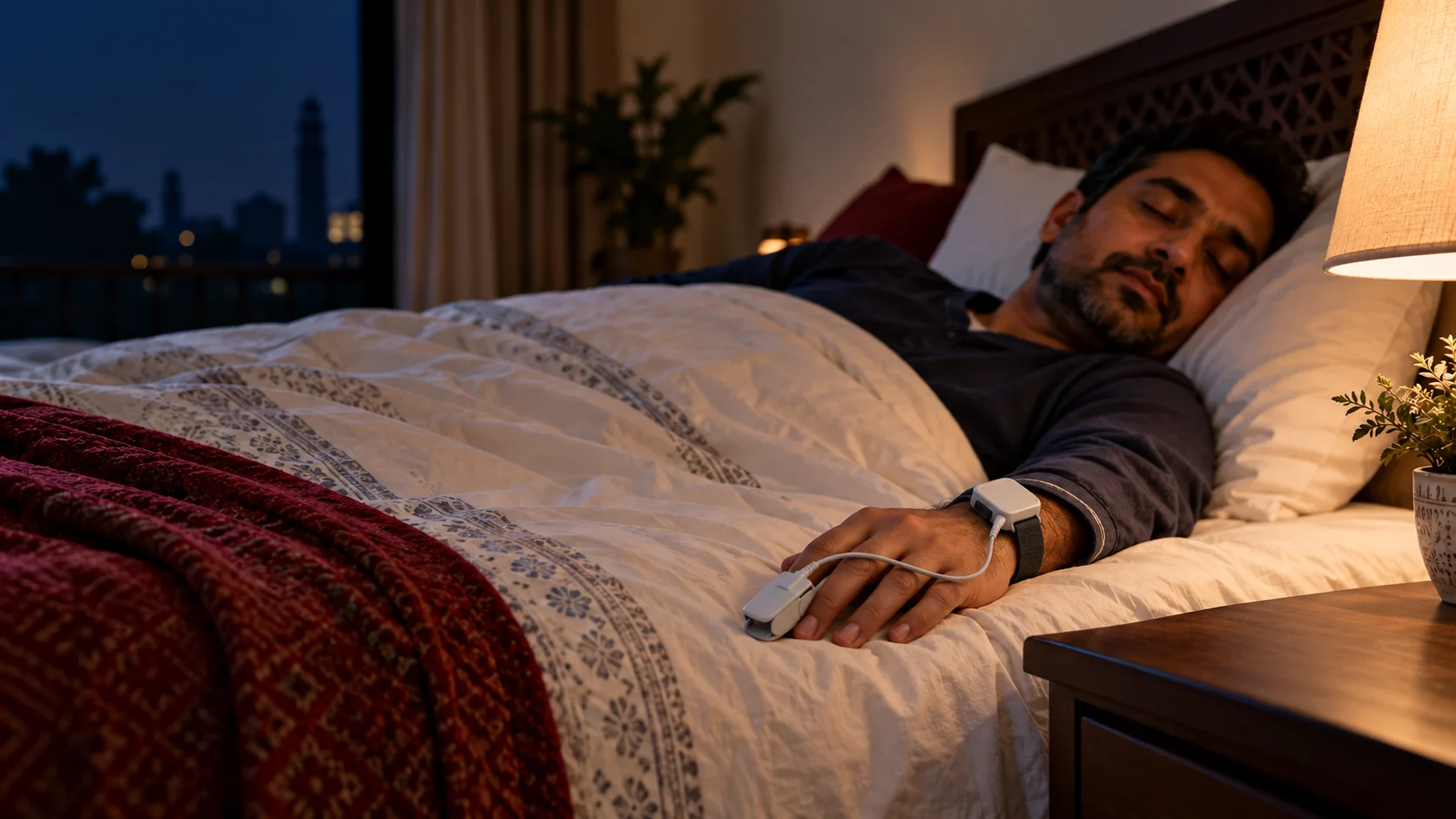
01 / The basics
What is overnight pulse oximetry?
Overnight oximetry, also called nocturnal oximetry, records an estimate of SpO₂—the percentage of haemoglobin carrying oxygen in the blood—throughout a night. At Australian Polyclinic, a light-based finger probe connects by a short cable to a small recorder worn on the wrist, like a watch. The recorder stores a series of readings rather than the single number shown by a household pulse oximeter. It commonly records the pulse at the same time.
The trace may show stable oxygen levels, repeated short drops or a more sustained period of low oxygen. That pattern helps a clinician decide whether the recording fits the symptoms and whether another test is needed. A trace does not say why oxygen fell without the clinical context.
The crucial difference: oximetry estimates oxygen and pulse. It does not record whether air moved through the nose, whether the chest tried to breathe, whether you were actually asleep, or your carbon dioxide level.
02 / Clinical uses
Who might be offered the test?
A clinician may consider overnight oximetry when the question is specifically about oxygenation during sleep. Examples include an established lung condition with concern about night-time desaturation; unexpectedly low daytime oxygen readings; or a check during follow-up when a person already uses CPAP or prescribed oxygen. It can sometimes help prioritise further assessment for suspected sleep-disordered breathing.
People with COPD, interstitial lung disease, heart disease or obesity-related breathing problems can have complex causes of low oxygen. In those situations, the pattern must be interpreted alongside history, examination and other investigations. If the main concern is loud snoring, witnessed pauses, gasping or daytime sleepiness, a sleep assessment and an appropriate home sleep study may answer the question more directly.
An overnight oximetry test may also be considered in selected patients already receiving treatment, to investigate persistent symptoms or concern about oxygenation. Any interpretation on CPAP must include the machine’s usage, leak and treatment data; oxygen readings alone cannot confirm adequate control of sleep apnoea.
If you have severe or worsening breathlessness, chest pain, blue lips, confusion or a concerning low oxygen reading with symptoms, seek urgent medical care. An overnight test is not an emergency assessment.
03 / Choose the right question
How is it different from a sleep study or lung test?
| Assessment | What it primarily records | What it helps answer |
|---|---|---|
| Spot pulse oximetry | A single oxygen estimate and pulse at one moment | What is the oxygen estimate right now? |
| Overnight oximetry | A continuous oxygen and pulse trace across a night | Does oxygen appear to fall during the recording? |
| Level 2 home sleep study | Sleep stages, airflow, breathing effort, oxygen and other signals | Are there breathing events during sleep and what type of sleep disruption occurs? |
| PFT / six-minute walk test | Lung function / oxygen and exercise response | How do the lungs work when awake / what changes with exertion? |
| Arterial blood gas | Oxygen, carbon dioxide and acid–base balance in an arterial sample | Is there low oxygen or raised carbon dioxide when sampled? |
These tests complement one another. A pulmonary function test explores lung mechanics and gas transfer; a six-minute walk test examines oxygen during exertion. Neither replaces an overnight recording. Likewise, an overnight oximetry result does not replace a detailed sleep study when the question is why breathing is disturbed during sleep.
04 / Your night
What happens before, during and after the test?
Clarify the question
Tell the team about snoring, pauses in breathing, lung or heart disease, medicines, smoking, CPAP, oxygen use and any previous sleep results. Ask which test is intended.
Fit the sensor
Follow the fitting instructions for the wrist-worn recorder and connect its cable to the finger probe. Keep that fingernail free of polish or an artificial nail, and make sure the probe fits without pinching.
Sleep as usual
Record bedtime, waking time, periods you were awake and whether the sensor came loose if asked. Tell the team if you used CPAP or prescribed oxygen. Do not alter either without your clinician’s instructions.
Return and review
The recording is checked for usable signal and reviewed with your symptoms. A repeat recording or a different test may be recommended if the data are poor or the result does not answer the question.
Keep hands warm if possible, avoid tugging the cable and follow the clinic’s instructions about bathing, device start and return. Tell the team if you sleep unusually little, have a cold or used alcohol, sedatives or other medicines that could affect the night. Do not stop prescribed medicines on your own.
05 / The report
What do the oxygen numbers mean?
A report is more than one “lowest oxygen” number. Your clinician may review the overall trace, the recording’s technical quality and several summary measures:
- Average or median SpO₂: an estimate of oxygen across the usable recording; a single average can hide short or sustained drops.
- Oxygen desaturation index (ODI): the number of qualifying oxygen drops per hour of analysed recording. The report should say whether a drop is defined as 3% or 4%. ODI is not the apnoea–hypopnoea index (AHI) from a sleep study.
- Time below a stated threshold: for example, time or percentage of the usable recording with SpO₂ below 90% (often called T90). It is recording time, not confirmed sleep time, when no sleep-stage signals are available.
- Lowest recorded SpO₂: this number should be checked against the trace, because a loose sensor or movement can create a false brief low.
- Pulse trend and signal quality: pulse changes and gaps may help assess whether the trace is credible, although pulse by itself does not identify a breathing event.
Clusters of repeated dips may raise suspicion of sleep-disordered breathing. A steadier, prolonged fall can suggest another pattern of nocturnal hypoxaemia. Neither shape is a diagnosis: the same trace can have more than one possible explanation, and artefacts can mimic real falls.
There is no single number that decides everyone’s treatment. Thresholds depend on the clinical setting, baseline oxygen level, recording quality, altitude, comorbid illness and the question asked. Discuss the whole report rather than a screenshot of its minimum value.
06 / What it cannot establish
Why a normal or abnormal trace needs context
- It does not confirm or exclude obstructive sleep apnoea. Some breathing events end in an arousal without a large oxygen drop. A normal trace can coexist with clinically important symptoms.
- It cannot tell obstructive from central breathing events or reliably diagnose sleep-related hypoventilation. It does not measure carbon dioxide. These questions need more suitable investigations.
- It cannot determine whether you need oxygen therapy by itself. Assessment of daytime oxygenation, blood gases and the underlying condition may be needed. Oxygen should never be started or adjusted solely from an unreviewed home trace.
- The estimate can be wrong. Movement, a loose sensor, cold hands, poor circulation and nail products can affect the result. Accuracy can also vary with skin pigmentation; report symptoms even if the reading looks reassuring.
- It cannot prove you were asleep. Long awake periods can change a nightly average or an events-per-hour measure.
For suspected COPD with sleep apnoea or suspected obesity hypoventilation, NICE advises against using oximetry alone to make the relevant diagnosis. A clinician may prefer respiratory polygraphy, polysomnography, blood gas testing or another assessment depending on the situation.
07 / Common questions
Overnight oximetry FAQs
Can overnight oximetry diagnose sleep apnoea?
It may show a pattern that raises concern, but oxygen drops alone cannot determine whether an event was obstructive, central or caused by another condition. For suspected sleep apnoea, your physician selects an appropriate sleep test and interprets it alongside symptoms.
Can a normal result rule out sleep apnoea?
No. Some events cause awakenings without a large oxygen drop; mild or positional disease can also be missed on a particular night. Persistent snoring, witnessed pauses or significant sleepiness deserve a clinical review even after a reassuring trace.
Will the test tell me whether I need home oxygen?
It may contribute evidence about night-time oxygenation, but an oxygen prescription requires clinical assessment and often other measurements. Never change oxygen flow or start oxygen based on an app or an unreviewed report.
Can I do it while using CPAP?
Sometimes, when a clinician has a specific follow-up question. Use CPAP as prescribed during the recording if that is the instruction and provide device reports. The oximetry result alone cannot establish that CPAP settings or control of sleep apnoea are adequate.
Is a smartwatch overnight oxygen graph the same test?
No. Our wrist-worn medical recorder uses a connected finger sensor and produces an overnight trace for clinical review. A consumer smartwatch may estimate oxygen intermittently and is not the same test. Show any concerning wearable data to your clinician, but avoid interpreting isolated low values on their own.
How many nights will I need?
It depends on the question, device, data quality and the clinician’s plan. One night may be informative, but a poor signal or unusual night may call for a repeat or a more detailed study. Confirm the instructions when booking.
Keep exploring
Related sleep and respiratory guides
Australian Polyclinic · Lahore
Book overnight oximetry in Lahore
Overnight oximetry is available at Australian Polyclinic. Call or WhatsApp 0311 057 3333 to book your test. Dr G Sarwar Chaudhry, consultant pulmonologist and sleep physician, can advise if a more detailed sleep study or another respiratory assessment would better answer your clinical question.
Request a booking →Book via WhatsApp →Australian Polyclinic · First Floor, Building 19, CCA, DHA Phase 5, Lahore · 0311 057 3333. Clinic Monday–Saturday, 2–9 pm; Dr Sarwar consultations, 4–8 pm.
Clinical sources
- NICE NG202: obstructive sleep apnoea/hypopnoea syndrome, assessment and diagnostic testing.
- NICE NG202: COPD and sleep apnoea overlap; obesity hypoventilation syndrome.
- US FDA: pulse oximeter basics and accuracy limitations.
- North Bristol NHS Trust: patient information about overnight oximetry.
This guide offers general information for adults and is not a diagnosis or a substitute for individual medical advice. Medically reviewed and approved by Dr G Sarwar Chaudhry, consultant pulmonologist and sleep physician, on 25 September 2026.